Country overview
Apprenticeship systems by country
Countries organise vocational training in very different ways. This overview sets twenty systems side by side and adds two open-data indicators for context.
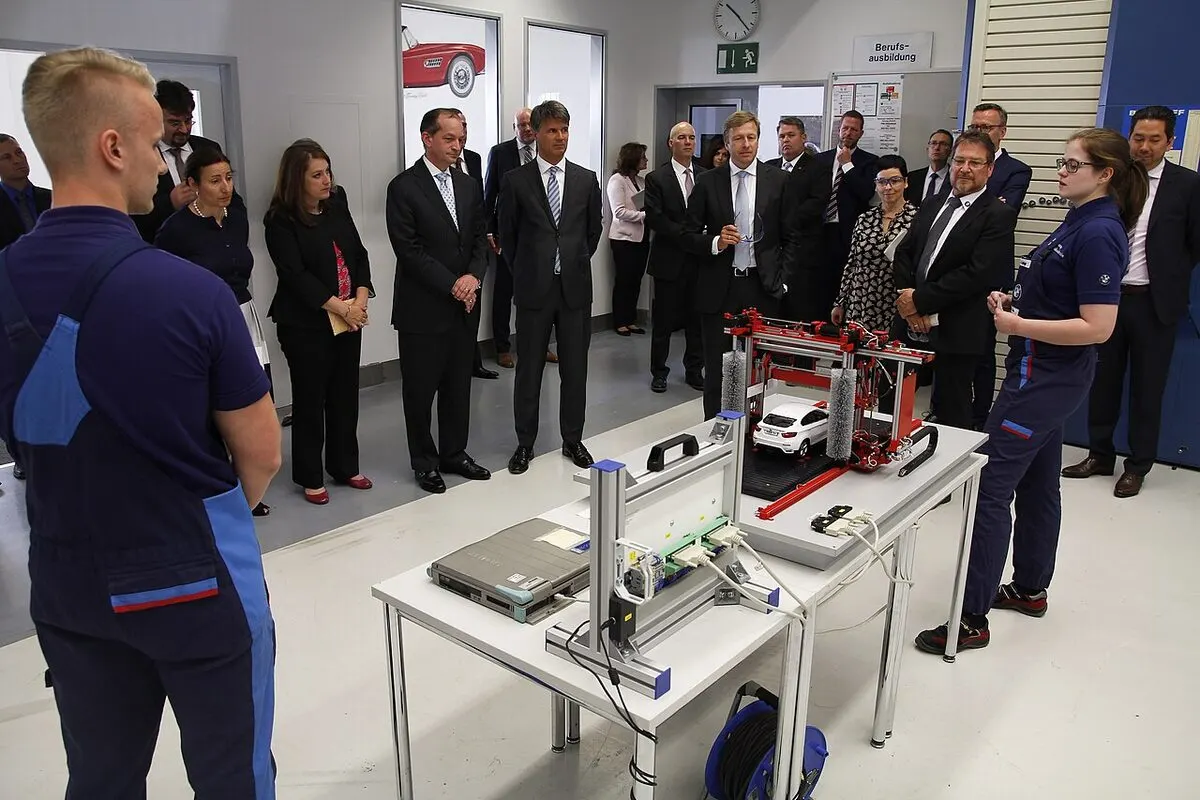
What makes an apprenticeship system work
Whatever the national label, successful systems share a handful of features. They line up with the principles in ILO Recommendation R195 on social dialogue, workplace learning, recognition of skills and quality assurance.
- A real contract. The apprentice has a defined status, usually with pay, rights and a fixed duration.
- Employers and unions at the table. Social partners help set occupational standards, so training matches what firms need.
- Learning in two places. Time at the workplace is combined with structured instruction in a school or training centre.
- A credential that travels. A recognised certificate lets the graduate move between employers and continue studying.
- Quality control. Trainers are qualified and programmes are checked by a competent body.
Twenty systems compared
The system descriptions are our own summaries of national arrangements and are simplified on purpose; check national sources before relying on a detail. The two numeric columns come from the World Bank database, with the year in brackets, and read "n/a" when no recent value exists. Statistical definitions differ, so the vocational share is not a direct measure of apprenticeship take-up.
| Country | System | Vocational share of upper secondary (%) | Youth NEET rate (%) | How it works |
|---|---|---|---|---|
| Austria | Dual apprenticeship (Lehre) with part-time vocational school, next to full-time vocational colleges. | 34.5 (2018) | 13.4 (2025) | Employers train on the job while the apprentice attends a vocational school (Berufsschule) one or two days a week or in blocks. |
| Brazil | Apprenticeship law plus sector training institutes. | 4.4 (2018) | 18.7 (2025) | Larger firms are obliged by the apprenticeship law to take on apprentices, and the sector training network (Sistema S, including SENAI) delivers much of the classroom part. |
| Colombia | Apprenticeship contract and a national training service (SENA). | 7.5 (2018) | 22.0 (2025) | The apprenticeship contract (contrato de aprendizaje) links a learning phase and a practical phase in a company, with SENA as the main public provider. |
| Denmark | Alternating school and workplace phases (EUD), shaped by the social partners. | 20.6 (2018) | 7.9 (2025) | Trade committees made up of employers and unions advise on programme content, and students alternate between college and a training company. |
| Estonia | School-based vocational education with a growing work-based learning track. | 22.6 (2018) | 10.9 (2025) | Vocational schools deliver most programmes, and work-based learning with employers has been expanded since the 2010s. |
| Finland | Competence-based vocational education with personal study plans, reformed in 2018. | 47.8 (2018) | 9.1 (2025) | Learners follow an individual plan that mixes school, on-the-job learning and an apprenticeship-style training agreement. |
| France | Alternance: apprenticeship contracts with a training centre (CFA). | 17.6 (2018) | 11.0 (2025) | Apprentices hold a work contract, spend part of the time in a training centre and prepare a recognised diploma; apprenticeship was reformed in 2018. |
| Germany | Dual system: company training plus part-time vocational school. | 19.2 (2018) | 8.2 (2025) | Training contracts run for roughly two to three and a half years, are regulated by the Vocational Training Act and are supervised by the chambers of industry and crafts. |
| India | Apprentices Act 1961 and the national apprenticeship promotion scheme. | 1.3 (2019) | 25.6 (2025) | Employers register apprentices under the Act; the national scheme supports part of the stipend cost for enterprises that engage them. |
| Japan | Mainly school-to-work hiring, specialised training colleges and in-company training. | 11.4 (2018) | 3.1 (2019) | Dual-style apprenticeship is small; large employers recruit graduates and train them on the job. |
| Mexico | Dual training model introduced in 2013, alongside technical colleges. | 27.7 (2018) | 16.2 (2025) | The Mexican dual training model brings company placements into technical upper-secondary programmes. |
| Netherlands | Secondary vocational education (MBO) with a school-based and a work-based route. | 37.4 (2018) | 3.9 (2025) | The BOL route is mainly school-based with internships; the BBL route is mainly work-based with a training contract. |
| Paraguay | Public vocational training services (SNPP and SINAFOCAL). | 15.9 (2016) | 18.6 (2017) | National services provide short vocational courses and training for work, with an emphasis on young people and informal workers. |
| Russia | Secondary vocational education in colleges, with dual elements piloted. | 14.3 (2018) | 6.7 (2025) | Colleges (SPO) deliver most vocational programmes; employer-linked dual training exists in selected regions and sectors. |
| South Africa | Learnerships and apprenticeships through sector education and training bodies. | 7.2 (2018) | 34.6 (2024) | Employers sign agreements with learners, with sector bodies and the quality council for trades and occupations involved in standards. |
| South Korea | Vocational specialised high schools and a work-learning dual system introduced in 2014. | 9.4 (2018) | n/a | The dual scheme combines workplace training and off-the-job learning for young people and in-service workers. |
| Spain | Dual vocational training (FP Dual), regulated since 2012 and reshaped by the 2022 vocational training law. | 18.8 (2018) | 9.4 (2025) | Combines study centres with company placements; the share of dual programmes has been growing from a low base. |
| Switzerland | Dual vocational education and training with a federal certificate. | 36.9 (2018) | 7.0 (2025) | Apprentices split the week between a host company and a vocational school; trade associations help define the content. |
| United Kingdom | Apprenticeships delivered by employers and training providers, differing across the four nations. | 31.8 (2018) | 14.4 (2025) | In England the apprenticeship levy has funded employer-designed standards since 2017; Scotland, Wales and Northern Ireland run their own schemes. |
| United States | Registered Apprenticeship overseen by the Department of Labor, plus community college programmes. | n/a | 11.6 (2025) | Registered programmes combine paid on-the-job learning and related instruction, and they cover a small share of young people compared with northern Europe. |
Data: World Bank World Development Indicators, which republish ILO modelled estimates (ILOSTAT) and UNESCO Institute for Statistics enrolment data. Snapshot retrieved 2026-10-23; source database last updated 2026-10-08. Vocational share: share of upper-secondary students enrolled in vocational programmes. NEET: youth aged 15-24 not in employment, education or training.
Where to go next
For the labour-market side of the picture, continue with youth employment, or open the full indicator tables with charts.